About ASSS 2026
(This is a hybrid event)
With the development of new software technologies and Application Programming Interfaces (APIs), software and system development becomes more complicated and requires for more advanced skill set. Such complexity may result in unwanted or unconscious bugs during the development phase, which can be utilized by cyber-attackers. The rapid evolution of technology (e.g., AI, quantum computing) and increasingly sophisticated cyber threats are driving major advancements in software and system security. As software is a crucial part of existing infrastructures, e.g., smart grid systems, how to secure the software and system security is a big challenge.
This conference aims to provide a platform for professionals from academia and industry to share advanced techniques, experiences and lessons learned for securing software and systems.
Conference features:
- A best paper award will be granted to the qualified papers.
- Good quality papers will be invited to SCI-indexed journal special issues:
-------------------------------------
Call for Papers:
Topics of interest include, but are not limited to the ones listed below.
- AI for Security
- Security for AI
- Code Obfuscation
- Anti-Debugging and Anti-Simulation
- Evaluation Methodologies
- Blockchain-based Methods
- Intrusion Detection / Firewall
- Malware Analysis
- Software Vulnerability
- Software Attack and Defenses
- Static and Dynamic Program Analysis
- Hardware-based Attacks and Defenses
- Formal Methods
- AI-based Security Techniques
- Adversarial learning
- Security testing
- Application security
-------------------------------------
Important Dates:
Submission Deadline: 14 September 2026 (Extended!)
Acceptance Notification: 10 October 2026 (Extended!)
Camera Ready: 25 October 2026
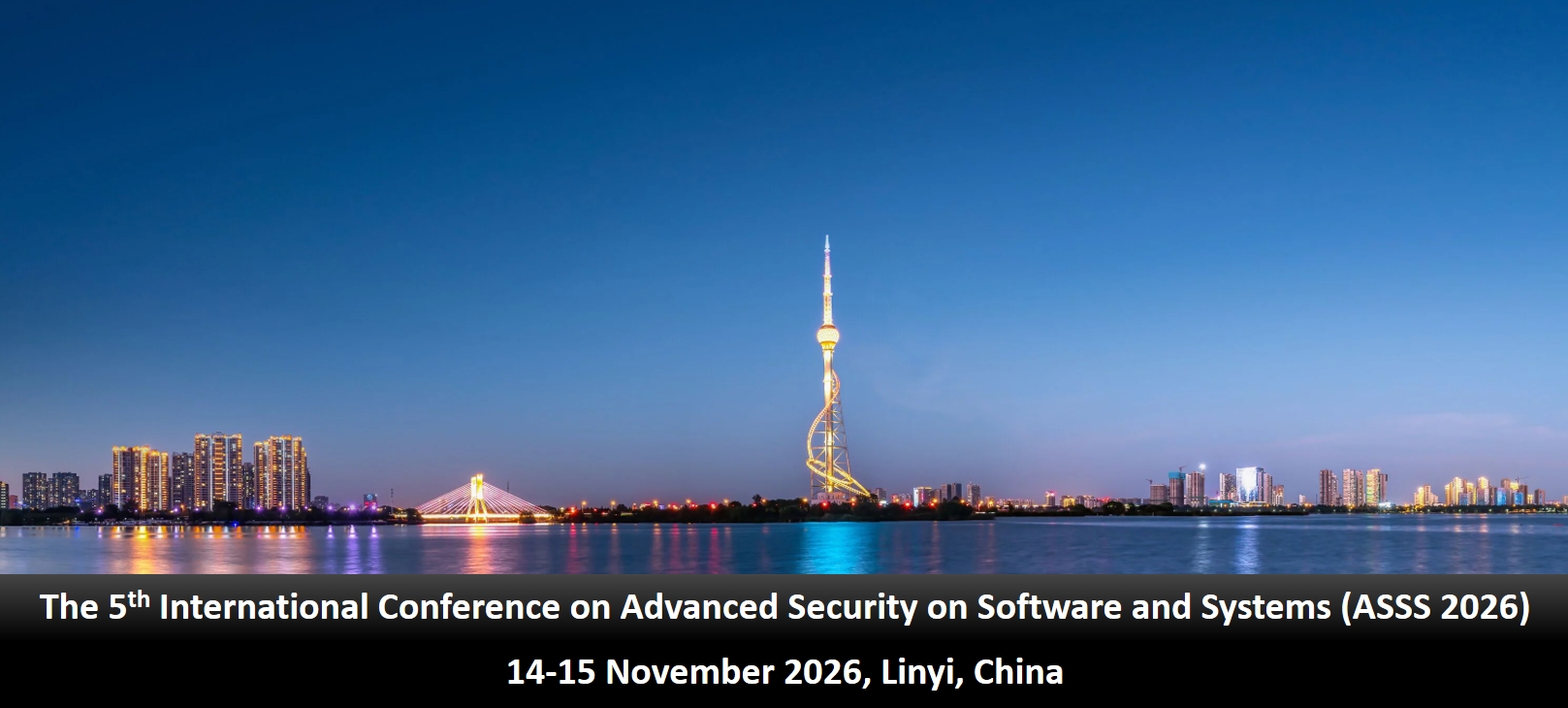
Conference dates: 14-15 November, 2026
-------------------------------------
For questions, please contact us at:
asss2026@easychair.org.
Organized by:
Linyi University, China
SPTAGE Lab, UK
Springer
News & Updates
7 August, 2026 ASSS 2026 submission deadline has been extended.
24 May, 2026 ASSS 2026 website is online.
Call For Papers
ASSS aims to provide a platform for professionals from academia and industry to share advanced techniques, experiences and lessons learned for securing software and systems.
-------------------------------------
Topics of interest include, but are not limited to the ones listed below.
- AI for Security
- Security for AI
- Code Obfuscation
- Anti-Debugging and Anti-Simulation
- Evaluation Methodologies
- Blockchain-based Methods
- Intrusion Detection / Firewall
- Malware Analysis
- Software Vulnerability
- Software Attack and Defenses
- Static and Dynamic Program Analysis
- Hardware-based Attacks and Defenses
- Formal Methods
- AI-based Security Techniques
- Adversarial learning
- Security testing
- Application security
Important Dates
| Submission Deadline | 14 September 2026 (extended!) |
| Acceptance Notification | 10 October 2026 (Extended!) |
| Camera-ready Copy Due | 25 October 2026 |
| Conference | 14-15 November 2026 |
Author Instructions
Authors are invited to submit original papers. All papers need to be submitted electronically through the website (https://easychair.org/conferences/?conf=asss2026) with PDF format. Submitted papers must not substantially overlap with papers that have been published or that are simultaneously submitted to a journal or a conference with proceedings. Papers must be clearly presented in English, must not exceed 18 pages (excluding well-marked references and appendix) in Springer LNCS/CCIS format (https://www.springer.com/gp/computer-science/lncs/conference-proceedings-guidelines), including tables, figures, references and appendices.
Submitted papers must not substantially overlap papers that have been published or that are simultaneously submitted to a journal or a conference with proceedings. All submissions should be appropriately anonymized, or will be rejected automatically. The submission should avoid obvious self-references and should be appropriately blinded.
Papers will be selected based on their originality, significance, relevance, and clarity of presentation assessed by at least three reviewers. Submission of a paper should be regarded as a commitment that, should the paper be accepted, at least one of the authors will register and attend the conference to present the work.
A best paper award will be granted.
The proceeding of this year's conference will be published by Springer. Author instructions and LaTeX/Word templates for LNCS/CCIS publications can be found via the following link.
Springer LNCS/CCIS Author Information
Journal Special Issues
Selected papers from ASSS 2026 will be invited to consider submission (after significant extension) for special issues:
Organising Committee
General Chairs
Weizhi Meng, Lancaster University, UK
Qingni Shen, Peking University, China
Wenjuan Li, The Education University of Hong Kong, China
Program Chairs
Jiuru Wang, Linyi University, China
Chunhua Su, The University of Aizu, Japan
Guangdong Bai, City University of Hong Kong, China
Publicity Chairs
Jiale Zhang, Yangzhou University, China
Wei-Yang Chiu, Technical University of Denmark, Denmark
Jingxue Chen, Nankai University, China
Publication Chair
Hongyuan Cheng, Linyi University, China
Local Chair
Jingcheng Song, Linyi University, China
Program Committee
Arcangelo Castiglione, University of Salerno, ItalyHongyuan Cheng, Linyi University, China
Xiao Chen, University of Newcastle, Australia
Ludovic Claudepierre, University of Rennes, France
Michel Cukier, University of Maryland, USA
Yao Li, Macau University of Science and Technology, China
Roberto Natella, Gran Sasso Science Institute, Italy
Xiaolei Ren, Macau University of Science and Technology, China
Jingcheng Song, Linyi University, China
Chunhua Su, University of Aizu, Japan
Guanping Xiao, Nanjing University of Aeronautics and Astronautics, China
Guofeng Tang, Singapore Management University, Singapore
Zhixin Zeng, Guilin University of Electronic Technology, China
Haofan Zheng, UC Santa Cruz, USA
Hiroaki Anada, University of Nagasaki, Japan
Raja Naeem Akram, University of Aberdeen, UK
Javier Parra Arnau, Karlsruhe Institute of Technology, Germany
Muhammad Rizwan Asghar, The University of Auckland, New Zealand
Maria Bada, University of Cambridge, UK
Joonsang Baek, University of Wollongong, Australia
Gergely Biczok, Budapest University of Technology and Economics, Hungary
Francesco Buccafurri, University of Reggio Calabria, Italy
Xiaofeng Chen, Xidian University, China
Jiageng Chen, Central China Normal University, China
Chen-Mou Cheng, Kanazawa University, Japan
Bernardo David, IT University of Copenhagen, Denmark
Changyu Dong, Newcastle University, UK
Csilla Farkas, University of Southern California, USA
Yunhe Feng, University of Washington, USA
Stefanos Gritzalis, University of Piraeus, Greece
Debasis Giri, Maulana Abul Kalam Azad University of Technology, India
Debiao He, Wuhan University, China
Shoichi Hirose, University of Fukui, Japan
Julian Jang-Jaccard, Massey University, New Zealand
Qi Jiang, Xidian University, China
Romain Laborde, University Paul Sabatier, France
Costas Lambrinoudakis, University of Piraeus, Greece
Albert Levi, Sabanci University, USA
Wenjuan Li, Hong Kong Polytechnic University, China
Qi Lin, The University of New South Wales, Australia
Giovanni Livraga, University of Milan, Italy
Leonardo Maccari, University of Venice, Italy
Mohammad Mamun, National Research Council, Canada
Sjouke Mauw, University of Luxembourg, Luxembourg
Weizhi Meng, Technical University of Denmark, Denmark
Mehrdad Nojoumian, Florida Atlantic University, USA
Chandrasekaran Pandurangan, Indian Institute of Technology, India
Davy Preuveneers, Katholieke Universiteit Leuven, Belgium
Pierangela Samarati, Universita' degli Studi di Milano, Italy
Jun Shao, Zhejiang Gongshang University, China
Spiros Skiadopoulos, University of Peloponnese, Greece
Ketil Stoelen, SINTEF, Norway
Chunhua Su, University of Aizu, Japan
Gang Tan, The Pennsylvania State University, USA
Je Sen Teh, Universiti Sains Malaysia, Malaysia
Andreas Veneris, University of Toronto, Canada
Hao Wang, Shandong Normal University, China
Haoyu Wang, Beijing University of Posts and Telecommunications, China
Licheng Wang, Beijing University of Posts and Telecommunications, China
Qionghong Wu, Beihang University, China
Zhe Xia, Wuhan University of Technology, China
Kuo-Hui Yeh, National Dong Hwa University, Taiwan
Wun-She Yap, Universiti Tunku Abdul Rahman, Malaysia
Steering Committee
Weizhi Meng, Lancaster University, UK
Accepted Papers
Registration Information
Registration payment is required by 3 November 2026 for EACH accepted paper. This deadline will be strictly enforced. Failure to pay the registration fee will result in the exclusion of the papers from the Conference Proceedings.
Registration Fee
| Registration Type | Registration Fee |
|---|---|
| Author Registration (paper authors) | 4300 CNY (600 USD) |
| Participant Registration (non-paper authors) | 1400 CNY (200 USD) |
How to register
Mode of payment
Payment should be made by fund transfer or depositing registration fees in the Bank account provided below.
- For non-Chinese Residents:
- For Chinese Residents:
You can register via this link
Please send your proof of payment and Name / Affiliation to (asss2026@easychair.org)
Remark: An invoice will be issued under ASSS2026
户名:青岛谷雨文化传媒有限公司
税号: 91370202MA3C86FGX9
单位地址: 山东省青岛市市南区北京路27号
开户银行:中国农业银行股份有限公司青岛中山路分理处
账号:38030201040007377
汇款备注信息:“ASSS2026#论文编号#姓名”
If you have any question about the registration or need any assistance, please do not hesitate to contact us (Dr. Song) by (13677735887@163.com).
Venue
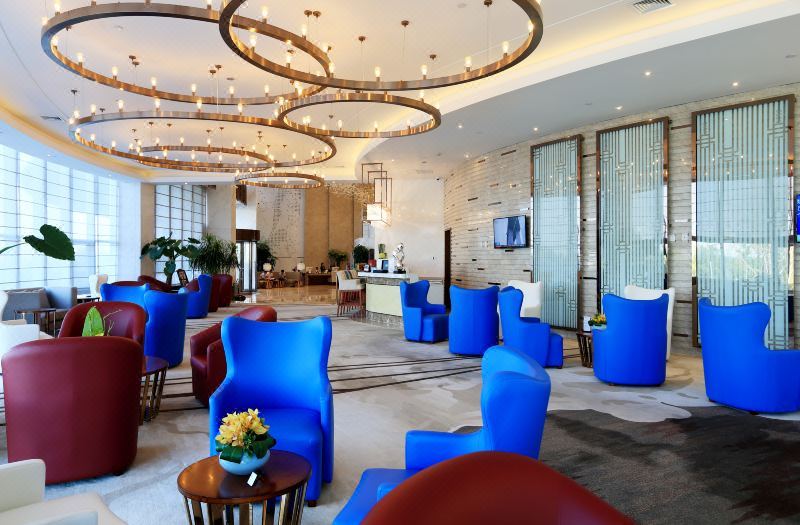
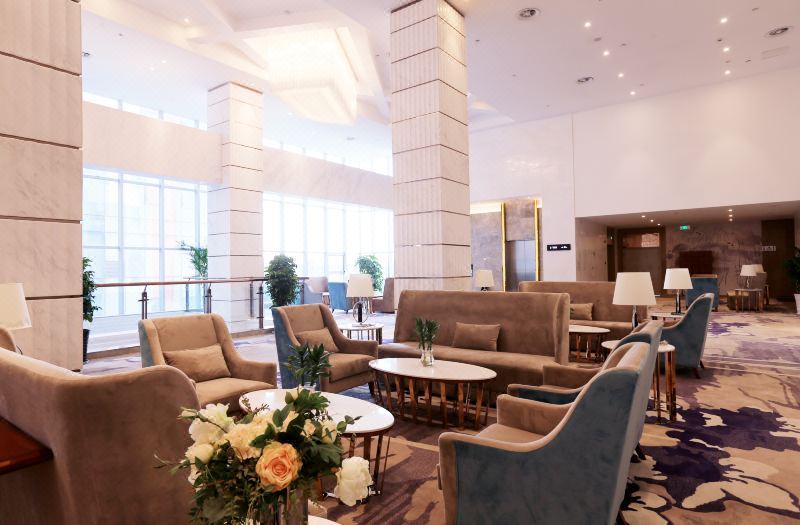
ASSS 2026 will be held at Linyi Chengfa Jinjiang International Hotel (No. 101, Lanting Road, Hedong District, Linyi).
More information can check:
Conference Location.


Information on Visa Applications
All participants of ISPEC2018 should be very careful about visa requirements and should make travel plan in advance enough. Visitors are fully responsible for acquiring all documents needed for entering Japan.
Japan provides waiver of visa requirements with more than 60 countries and regions. Please refer to the recent status on the visa waiver program from the Ministry of Foreign Affairs of Japan (MOFA).
If you need a visa for attendance, you should prepare all required documents according to the visa information page by MOFA. If you have any questions, please contact diplomatic establishments of Japan in your residential area.
We will issue an invitation letter ONLY for those who have presentation(s) at ISPEC2018 upon request. If you need an invitation letter for visa application, please send the following documents to
(ispec2018-visa *at* ml.cc.tsukuba.ac.jp)
(please replace *at* with @.)
after paying the registration fee via ISPEC2018 website and fixing your accommodation during the conference. (You can download a copy of participation information sheet and schedules of stay sheet from here.)
- Filled participation information sheet for invitation letter (MS-word and PDF format).
- Photo-copy of your passport (PDF format). (The page which your photo and passport number are included.)
- Photo-copy of student identification card (PDF format), if you are student. (The page(s) which your photo, name, and ID number are included.)
- Photo-copy of employee identification card (PDF format), if you are an employee. (The page(s) which your photo, name, and ID number are included.)
- Filled schedules of your stay sheet (MS-word or PDF format) with a proof of your stay (e.g., a confirmation e-mail, a receipt or an invoice from your accommodation).
We will respond with a detailed procedure for invitation letter request. Please make sure to make a registration for ISPEC2018 before the request.
Notices:
- Visa application to MOFA may take a long time. Please do it well before the deadline!
- We will normally respond to the first request in a few days.
- After receiving all required information, we will normally handle your requests in 1 or 2 weeks and the letter will be sent by a postal mail.
- We do not issue any form of "a letter of guarantee"
- We will issue invitation letters only for those who have presentation(s) at ISPEC2018.
- We hold rights to request any additional information and/or to decline your application for invitation letters.
- In case you need a document to be submitted to your organization prior to applying Visa, just let us know immediately.
- Registration cannot be cancelled once the Visa application related documents have been sent out to you.
About privacy:
According to the Act on the Protection of Personal Information Held by Independent Administrative Agencies and others of Japan, the information submitted to ISPEC2018 in this page will be kept secret and used only for processing the invitation letter requests. In some cases, ISPEC2018 will share those information with a part of organizing committee members concerned for resolving issues (e.g. checking registration status and paper acceptance etc.). We will not use any information received for other purposes, except those required by laws and rules of Japan.
If you have any question, please contact: ispec2018-info@ml.cc.tsukuba.ac.jp